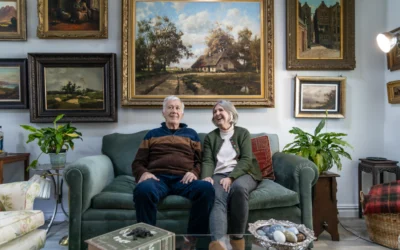
Five years of visiting Woodside, and I have never met Jess Mackintosh. That tells you everything you need to know about her. She is not someone who waits around. She is, in all likelihood, already knee-deep in Newlands Forest with the Pink Panthers, her walking group, or cutting through the cold ocean at Muizenberg before most of us have made coffee. Jess Mackintosh, Woodside resident for six years, is the kind of person who makes you quietly reconsider what you’ve done with your own morning.
Jess Mackintosh
A Builder of Peace
When we finally sat down together on the patio of her cottage, opening onto a private greenbelt alive with colour, two little mannikins landed at the bird feeder and stayed a while. It felt fitting. Even the birds come to Jess.
Born in Namibia, Jess moved to Cape Town for her secondary and tertiary education. Most of her contemporaries at the time went into nursing or teaching and none appealed to Jess. She settled with a BA, keeping the options as wide as possible. I don’t think Jess’s particular rhythm could ever be prescribed. She dabbled in horticulture, metallurgy which seemed to suit her quite naturally. She moved into property and when she inherited three cottages in Newlands, she converted them into a guest house that drew regulars from the UK and the States, friendships that have lasted decades. She opened a gym for older, unfit adults who needed somewhere to begin. Jess has always had a sharp eye for what is missing, and an instinct to simply build it. I think Jess is a healer and a builder. Quite a rare combination.
She looks, easily, twenty years younger than her age. She’ll tell you she doesn’t stress the small stuff, and you believe her, because she has learned how to measure what actually matters.
It was during the guest house years that her daughter got sick. Lindsay was 21. She had graduated from Westerford, earned her physiotherapy degree, top of her class. She was captain of the running team. She had boyfriends, a social life, a future that looked exactly as it should. Then something shifted. Lindsay was diagnosed with schizophrenia.
Jess is clear on the facts. Schizophrenia affects roughly one in a hundred people worldwide, regardless of race, gender, nationality, or educational background. There is a persistent belief that it runs in families, that there must be a genetic thread. In Jess’s case, there wasn’t one. Jess had pamphlets printed. She handed them to her friends. Education, she understood, was the first wall to knock down.
People living with schizophrenia may follow any number of paths: some experience a single episode and stabilise completely; others manage well with medication, living full and largely uninterrupted lives; and some are treatment-resistant. Medication helps, but does not silence everything. These are the people who need round-the-clock care, structure, belonging, and a place that feels nothing like an institution.
Jess with family in Arniston for her 80th

In 2000, that place did not exist. So Jess built it. She fundraised. She found a house. She put the house in a trust. Six friends became trustees; a psychiatrist, a lawyer, a marketer, and others who believed in what she was doing. She was insistent on one thing that might seem incongruous given the weight of it all: you must have fun. Valentine’s dinners. Fundraising parties. A Swiss business made a significant donation that changed the trajectory entirely. In October 2000, the Hope House Trust was officially registered as a charitable trust and later as a non-profit organisation. By December 2001, they had acquired 32 Peak Drive in Pinelands, a beautiful thatched house with a swimming pool and a garden that felt like the opposite of every cold, clinical space these young adults had known.
The activity calendar was non-negotiable. Four out of five days, something was planned, from bicycles from Virgin Active to art classes, drawing or sewing; the rhythmic, repetitive motion of it, Jess believes, seems to quieten the voices the residents might hear. It silenced them, she says. Simply, and without embellishment.
That is how Hope House was built: with the specific, practical intelligence of a mother who watched her daughter and other residents closely and asked what, exactly, was needed.
In April this year, Jess stepped down as Chairperson and her son has taken over the role. The work she began out of necessity has become something that no longer needs her at its centre to survive. That is the measure of it. Jess created infrastructure. She built something that will outlast her involvement in it, something that continues to house and hold people who, without it, would not know the peace of home.
Jess does not present herself as extraordinary. She is a straight talker; matter-of-fact in the way that people become when they have moved through enough of life to stop performing any of it. Her cottage is beautiful, earthy and warm. Her patio is peaceful. The greenbelt beyond it is green and unbothered.
Some people respond to what life asks of them. Others go further; they look at what is missing, and they build it. They do it with fun and with friends and with pamphlets and with bicycles and with knitting needles and sewing machines.
Jess Mackintosh is the latter, a proud mother of three, a gogo of five, dog lover, a builder of homes. And the kind of mother who, when she could not give her youngest daughter peace, went out and built a place where peace could live.
Hope House Trust is a registered non-profit organisation providing long-term residential care for adults living with schizophrenia. For more information, visit HopehouseTrust.co.za
By Adi Gelbart, for Woodside
Share on Facebook